
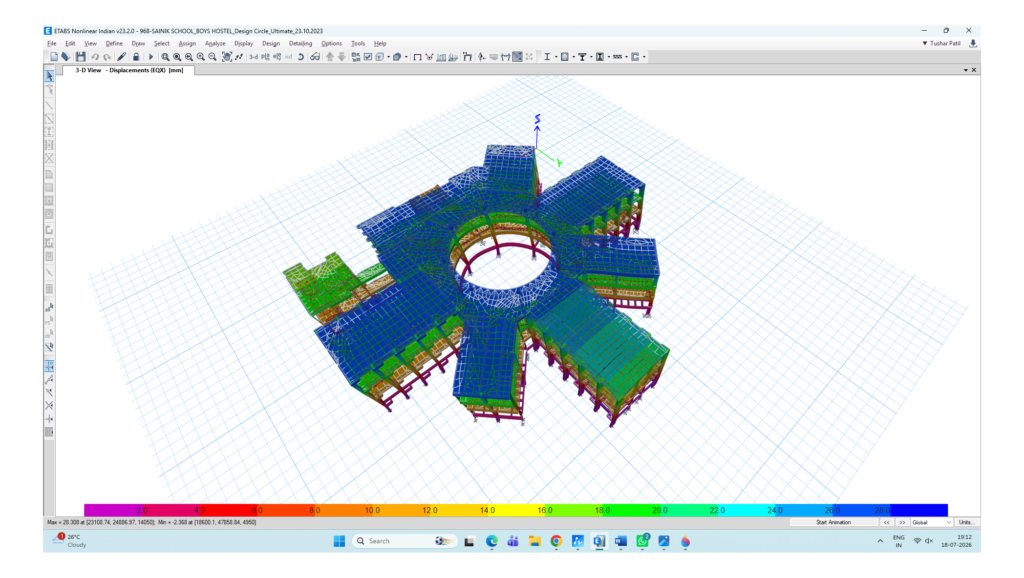
Structural Design Is More Than Just Software Analysis
Introduction
Modern structural engineering relies extensively on advanced analysis and design software. Complex buildings can now be modelled, analysed and evaluated with a level of speed and sophistication that was difficult to imagine a few decades ago.
However, a successful software analysis does not automatically mean that a structure is safe, efficient or constructible.
Software performs calculations based on the model, assumptions and inputs provided by the engineer. The quality of the final structural design therefore depends fundamentally on the engineering decisions made before, during and after the analysis.
A Structural Model Is an Engineering Interpretation
A real building is far more complex than its analytical model.
The structural engineer must decide how the actual structure should be represented mathematically. This includes defining:
- the structural framing system
- load paths
- member connectivity
- support conditions
- diaphragm behaviour
- member stiffness
- cracked section properties
- soil–structure interaction
- boundary conditions and
- interaction between structural and non-structural elements.
Two engineers can model the same building differently and obtain different results. The important question is not simply whether the model runs successfully, but whether it represents the expected behaviour of the actual structure.
Understanding the Load Path
One of the most fundamental principles of structural engineering is the load path.
Every load must have a clear and continuous route from its point of application to the foundation and ultimately to the supporting ground.
Gravity loads typically travel through:
Slab → Beam → Column / Wall → Foundation → Soil
Lateral loads may follow a more complex path through:
Floor Diaphragm → Shear Walls / Frames → Foundation System
If the load path is unclear, discontinuous or excessively indirect, the structure may develop unexpected force concentrations, transfer actions or local distress.
Software can calculate forces within the model provided. It cannot independently determine whether the selected structural concept is sensible.
Modelling Assumptions Matter
Several apparently small modelling decisions can significantly influence structural behaviour.
Examples include:
- incorrect mass source definition
- unrealistic stiffness modifiers
- improper diaphragm assignment
- missing or unintended member releases
- inadequate slab or wall meshing
- incorrect support conditions
- duplicate structural elements
- disconnected nodes
- inappropriate treatment of secondary members and
- incorrect representation of transfer levels.
A model may show no errors and still contain assumptions that do not reflect the actual structure.
Engineering Judgment Is Essential
- Does the deflected shape look reasonable?
- Is the load distribution logical?
- Are reactions consistent with the applied loads?
- Are mode shapes physically meaningful?
- Is torsion expected or caused by modelling?
- Are force concentrations real or numerical?
- Is the structural system stable and efficient?
Design Must Consider Constructability
- heavily congested reinforcement
- impractical beam-column junctions
- excessive reinforcement layers
- abrupt changes in member sizes
- difficult wall boundary detailing
- complex transfer systems and
- reinforcement arrangements that cannot be properly placed or concreted.
Drawings and Detailing Complete the Design
The structural model is only one part of the engineering process.
The structure is ultimately built from drawings and specifications. Clear reinforcement detailing, anchorage, laps, construction joints, connection details and coordination with architectural and MEP requirements are essential to ensure that the design intent reaches the site.
The Designage Approach
- structural concept development
- realistic analytical modelling
- independent result verification
- code compliance
- constructability review
- reinforcement detailing and
- coordination during execution.